
Network Introduction
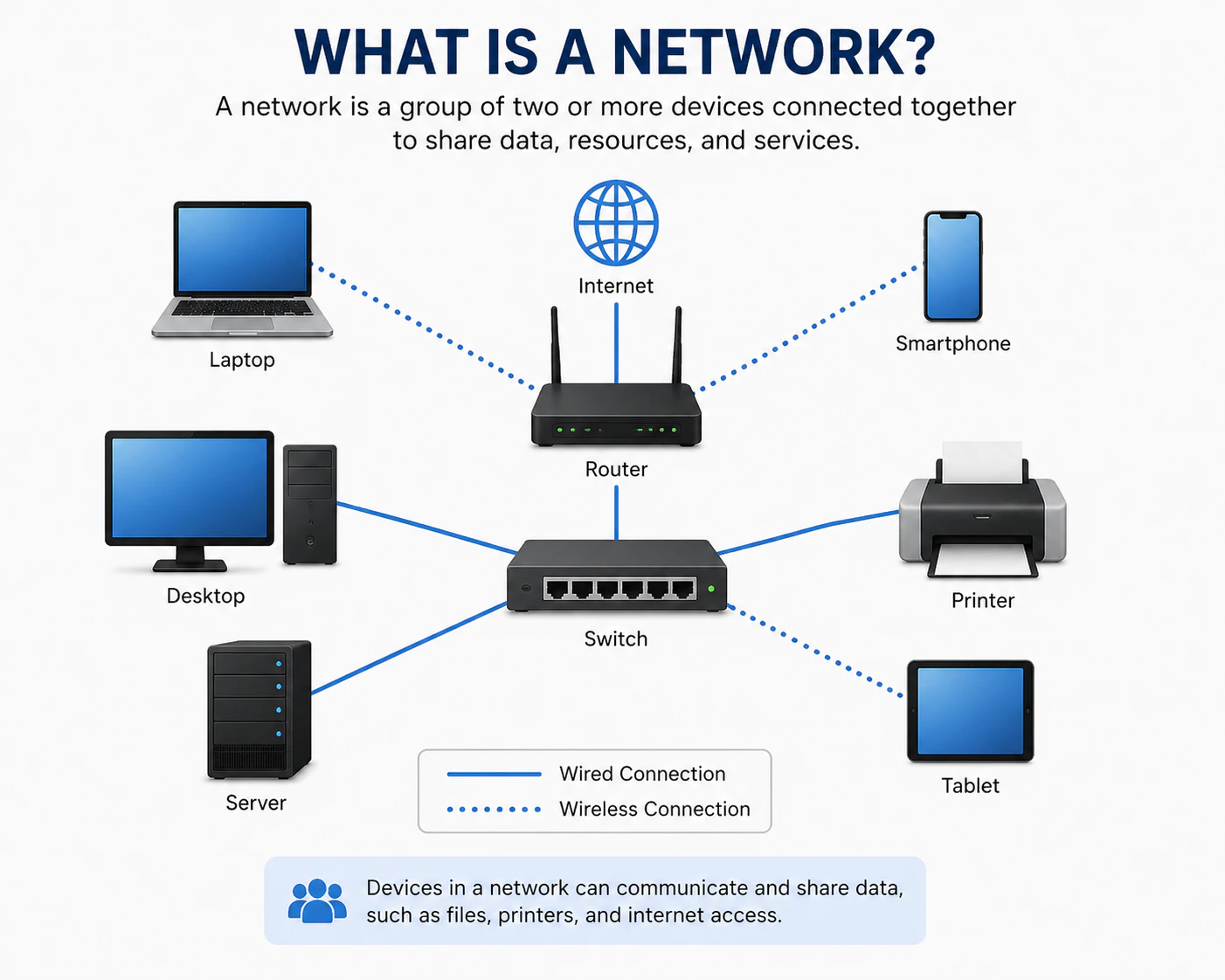
A network is a collection of devices (often called nodes) that are connected together so that they can communicate with each other to exchange data and resources. A network consists of two main components.Nodes (The Devices)
The devices in a network can include computers, servers, printers, smartphones, routers, switches and other electronic devices. Any device connected to a network is considered a node.
Links (The Connections)
The connections between the devices in a network are called links. These links can be physical (like Ethernet cables) or wireless (like Wi-Fi). They allow the devices to communicate and share data with each other.
How networks work?
What is a Packet?A packet is a small unit of data that is transmitted over a network. When you send data over the internet, it is broken down into smaller pieces called packets. A packet can be broken down into three main parts:
- Header (Label): Contains information about the packet, such as the source and destination IP addresses, packet number, protocol, and time-to-live (TTL).
- Payload (Actual Data): The heart of the package, which contains the actual data being transmitted, such as a portion of a web page, an email message, or a file.
- Trailer (Footer): Contains error-checking information to ensure that the packet has been transmitted correctly. It may include a checksum or cyclic redundancy check (CRC) to detect any errors that may have occurred during transmission. It uses mathematical calculation to verify whether the integrity of the packet is intact or not. If the calculated value does not match the value in the trailer, it indicates that the packet has been corrupted during transmission and may need to be retransmitted.
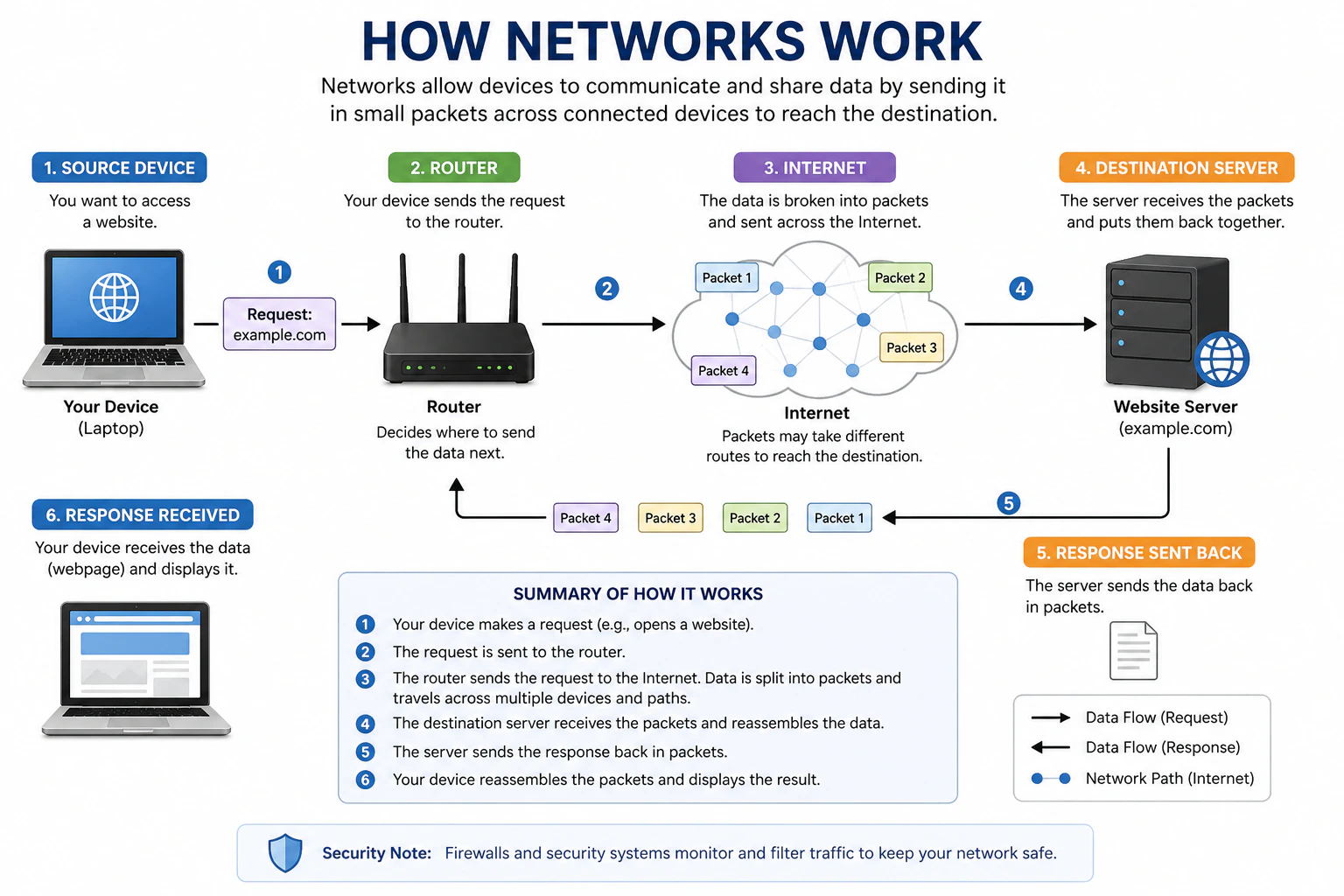
- You want to access a website on your laptop.
- You type the website’s address (URL) into your browser and hit enter.
- Your laptop sends a request to the router, which is the device that connects your home network to the internet.
- The router sends the request to the Internet. Data is split into small packets and transmitted across multiple devices and networks until it reaches the server hosting the website.
- The destination server receives the packets and reassembles the data to process your request.
- The server sends the response back in the form of data packets, which travel back through the network to your laptop.
- Your laptop receives the packets, reassembles them, and displays the website in your browser.
Why do we need networks?
Without networks, each device would be isolated and unable to communicate or share resources with other devices. Networks enable:- Resource sharing: Instead of each user needing their own printer, they can share a single printer on the network. This is more cost-effective and efficient.
- Instant communication and collaboration: Networks allow users to communicate and collaborate in real-time, regardless of their physical location. This is essential for businesses, education, and social interactions. For example, tools like Email, Slack, etc.
- Centralized data management: Networks allow for centralized storage and management of data, making it easier to back up, secure, and access information from multiple devices.
- Access to the internet: Networks provide access to the internet, which is a vast resource of information, services, and communication tools. This has transformed how we work, learn, and interact with the world.