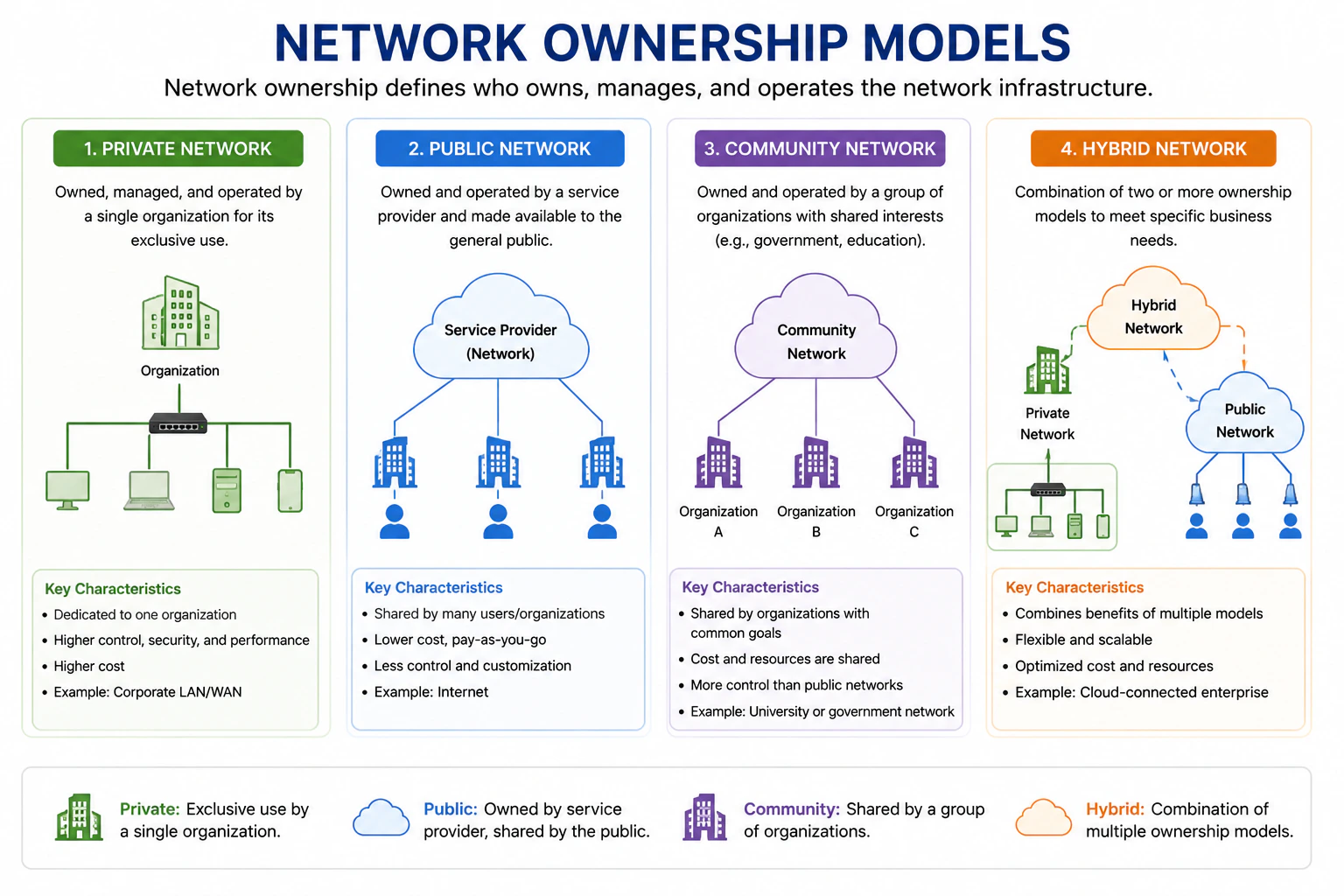
Network ownership refers to who is responsible for managing and controlling the network resources and connections. Networks can be categorized into different ownership types based on who has control over them.
Private networks are owned and managed by individuals, organizations, or businesses. They are typically used for internal communication and data sharing. They require authentication for access and are not accessible to the general public.
Examples; home Wi-Fi, corporate intranet, school networks.
Hybrid networks combine elements of both public and private networks. Most organizations use hybrid networks to balance security and accessibility.
Examples of common hybrid scenarios;
Private + Public: A company maintains a private network for internal operations or sensitive data, while also providing public Wi-Fi for customers or visitors.
On-Premises + Cloud: A hospital uses an on-premises private network for patient records and a cloud-based public network for telemedicine services.
The Bridge: Typically, these networks are conected through a secure gateway or VPN, allowing for controlled access between the private and public segments.
Community networks are owned and operated by a group of individuals or organizations or local government within a specific community. They are often created to provide internet access in underserved areas (Some areas no public internet access) or to foster local connectivity.
Examples; neighborhood mesh Wi-Fi, community mesh networks, local cooperative networks.
Understanding network ownership is crucial for network design, security, and management. Here’s a quick summary of the different network ownership types and their best use cases:
Network Ownership Type
Description
Best Use Cases
Public Network
Owned and operated by third-party service providers, accessible to anyone.
General internet access in public spaces.
Private Network
Owned and managed by individuals, organizations, or businesses, requiring authentication for access.
Internal communication and data sharing within organizations.
Hybrid Network
Combines elements of both public and private networks, often connected through a secure gateway or VPN.
Balancing security and accessibility in organizations.
Community Network
Owned and operated by a group of individuals or organizations within a specific community.
Providing internet access in underserved areas or fostering local connectivity.